I wrote an article for Textiles Asia entitled, “Text vs. Textile - How Two Sisters Tell Us Who They Were by What They Wore” (January, 2026 issue). When it printed, the publisher’s software corrupted the spelling of most of the Sanskrit words. You can find the correct spellings below.
The Sanskrit Lexicon of Angkor
apsarā (f.) अप्सरा celestial nymph “AP-sa-ra”
“‘going in the waters or between the waters of the clouds,’ a class of female divinities… they inhabit the sky, but often visit the earth; they are the wives of the Gandharvas… and have the faculty of changing their shapes at will; they are fond of the water; one of their number, Rambha, is said to have been produced at the churning of the ocean” There’s no mention of the ability to fly. Not all apsarā were produced at the churning of the ocean (only Rambha). Apsarā are married.
devatā (f.) देवता with gods “DAY-vata”
“godhead, divinity…; image of a deity, idol; … of the organs of sense…; … with divinity, i.e. with a god (gods) or among the gods…” There are 4 meanings – the last is the one that applies to the largest group of women at Angkor Wat.
devī (f.) देवी queen “DAY-vee”
“the consecrated wife or daughter of a king, but also any woman of high rank”
dvārapāla (m.) द्वारपाल of yaksha “DVA-ra-pa-la”
“Of various Yakshas and of sacred places connected with them…” (dvāra = door, gate, passage, entrance)
dvārapālikā (f.) द्वारपालिका of yakshī “DVA-ra-pa-likā” Female dvārapāla
gandharva (m.) गन्धर्व celestial guardian of soma “gan-DHAR-va”
“… his habitation is the sky, or the region of the air and the heavenly waters; his especial duty is to guard the heavenly Soma…” Gandharva are married to apsarā. Soma is the juice of the soma plant, fermented and then offered to the gods.
jaya (m.) जय victorious in battle “JAya”
“…being victorious… in battle…” The 1st part of the name taken by Jayavarman VII when he ascended the throne.
karuṇā (f.) करुणा compassion “kurooṇā” “compassion” (Monier-Williams p. 255; Pou p. 197)
Kshatriya (m.) क्षत्रिय the caste group below Brāhman “KSHA-triya” “A member of the military or reigning order…”
nagara (m.) नगर city “NAG-ara” “city” Word from which “Angkor” evolved (Monier-Williams p. 525; Pou p. 282)
nāga (m.) नाग snake “NA-ga” “snake”
prāsāda (m.) प्रासा temple, palace “pra-SA-da” “…palace, temple…” Word from which “prasat” evolved (a brick or stone temple).
pūjā (f.) पूजा ceremony to honor the gods “PU-ja” “… adoration of the gods” Pūjā can still be seen in India and Cambodia today.
rāja (m.) राज sovereign “RA-ja” “… a king, sovereign, chief or best of its kind…”
varman (m.) वर्मन् protection “VARman”
“armour… protection… (often at the end of the names of Kshatriyas)…” The last part of the name taken by the Angkorian kings.
varṇa (m.) वर्ण caste group “VAR-na”
“… the four… classes described in Manu’s code… Brāhmans, Kshatriyas, Vaiśyas, Śūdras; the more modern word for ‘caste’ being ‘jāti’…”
yakshī (f.) यक्षी semi-divine atten-dant of Vishnu “YAK-shee”
“A … spiritual apparition, ghost, spirit… of a class of semi-divine beings (attendants of Kubera, exceptionally of Vishnu…)” (Kubera is the king of the yaksha.) The male counterpart of a yakshī is a yaksha, but yakshī are not married to yaksha.
The Sanskrit Names of the 7 Groups of Women at Angkor Wat (by rank, in descending order)
yakshī यक्षी The 24 women guarding the inner sanctum (8 guard the doors). Zhou Daguan didn’t mention them because he only wrote of mortals.
apsarā अप्सरा The dancing apsarā, on the western entrance to the temple compound and on pillars inside the temple. Zhou Daguan didn’t mention them because he only wrote of mortals.
apsarā अप्सरा The floating apsarā, above the Sea of Milk. Zhou Daguan didn’t mention them because he only wrote of mortals.
devī देवी The 5 queens. Zhou Daguan called them, “royal wives”.
? The 6 women who follow the queens. Zhou Daguan called them, “servants in carts”. We don’t know their Sanskrit name.
? The bearers of vessels. Zhou Daguan called them, “girls carrying gold and silver vessels”. We don’t know their Sanskrit name.
devatā देवता The 1860+ women standing on the walls. Zhou Daguan called them, “girls of the palace… gaily dressed, with flowers in their hair”.
*************************
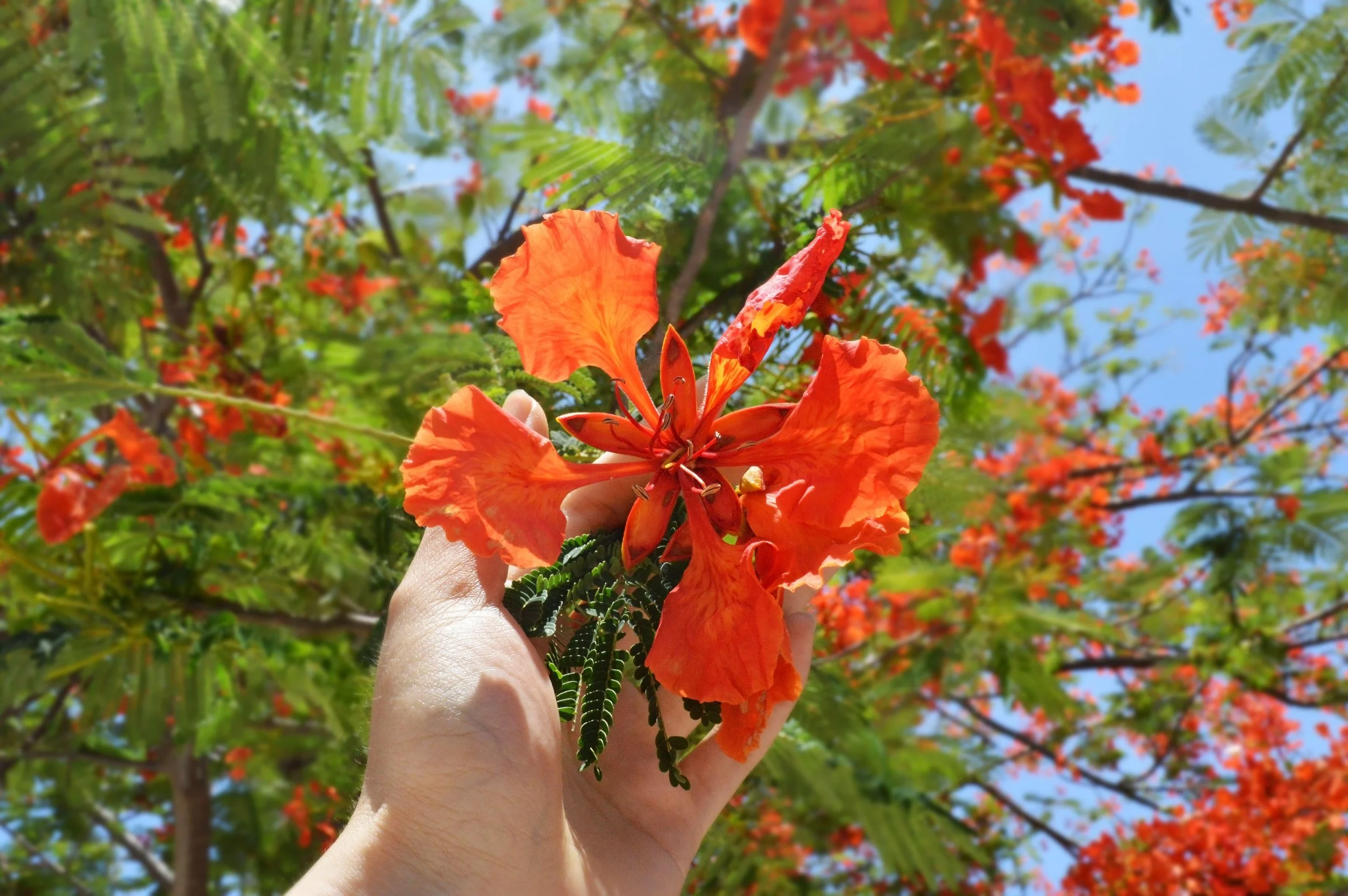
Below, the Royal Poinciana flower - the pattern on the sister queens’ skirts in the Preah Khan temple. The top petal, red and white, has curled because the flower is old. Photo by Hang Tran, from Alamy.com